Accounting
Not reports bolted on. Real books that reconcile to zero.
Every verified payment posts balanced double-entry records. The P&L knows whose money each unit earns. And the month actually closes, with accruals, a treasury ledger, and a break-even day you can point to.
Verified in, balanced out
Nothing becomes revenue until a person says so.
Guests pay by bank transfer or cash with a proof upload. A person on your team verifies each proof; only then does the payment post, as balanced double-entry records in a ledger that must reconcile to zero. No hopeful spreadsheet rows, no "probably paid".
How guests pay from a chat →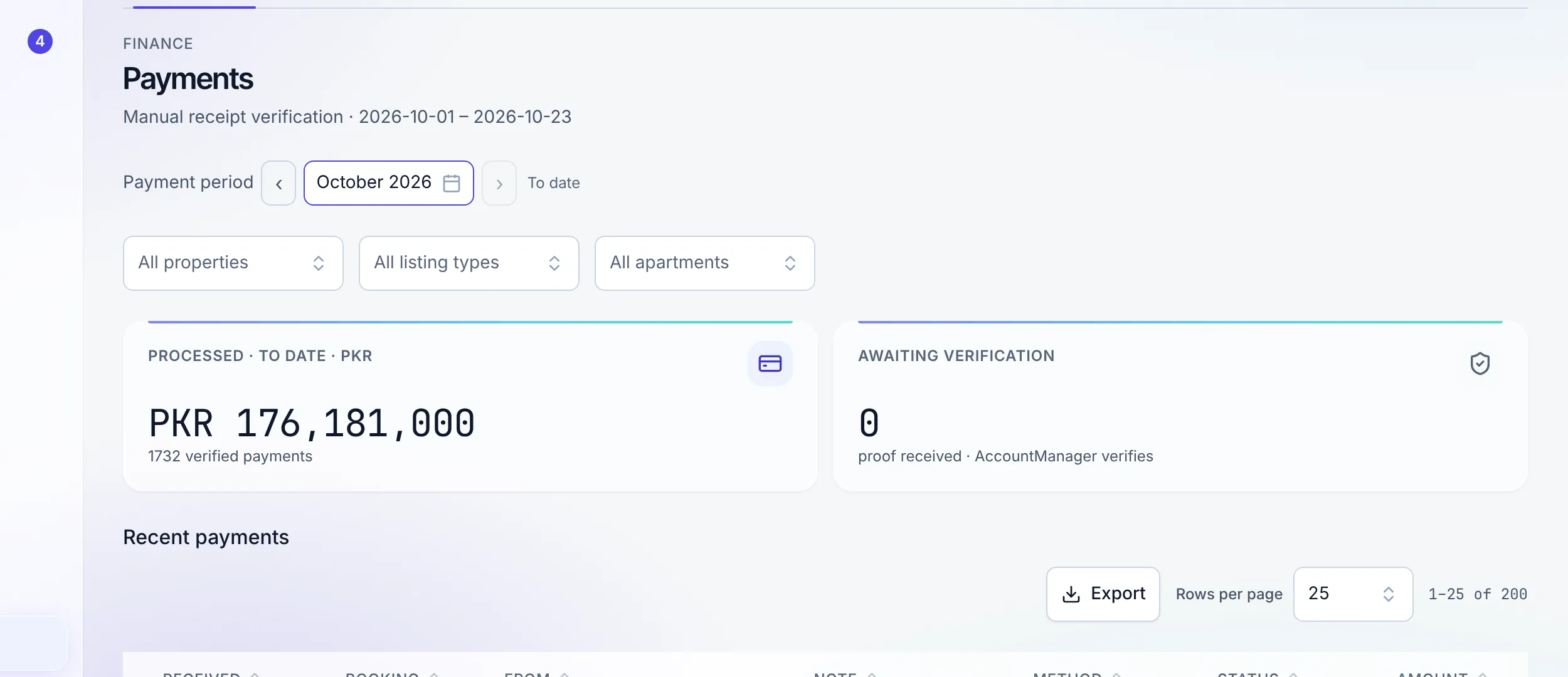
Five operating models
The P&L knows whose money it is.
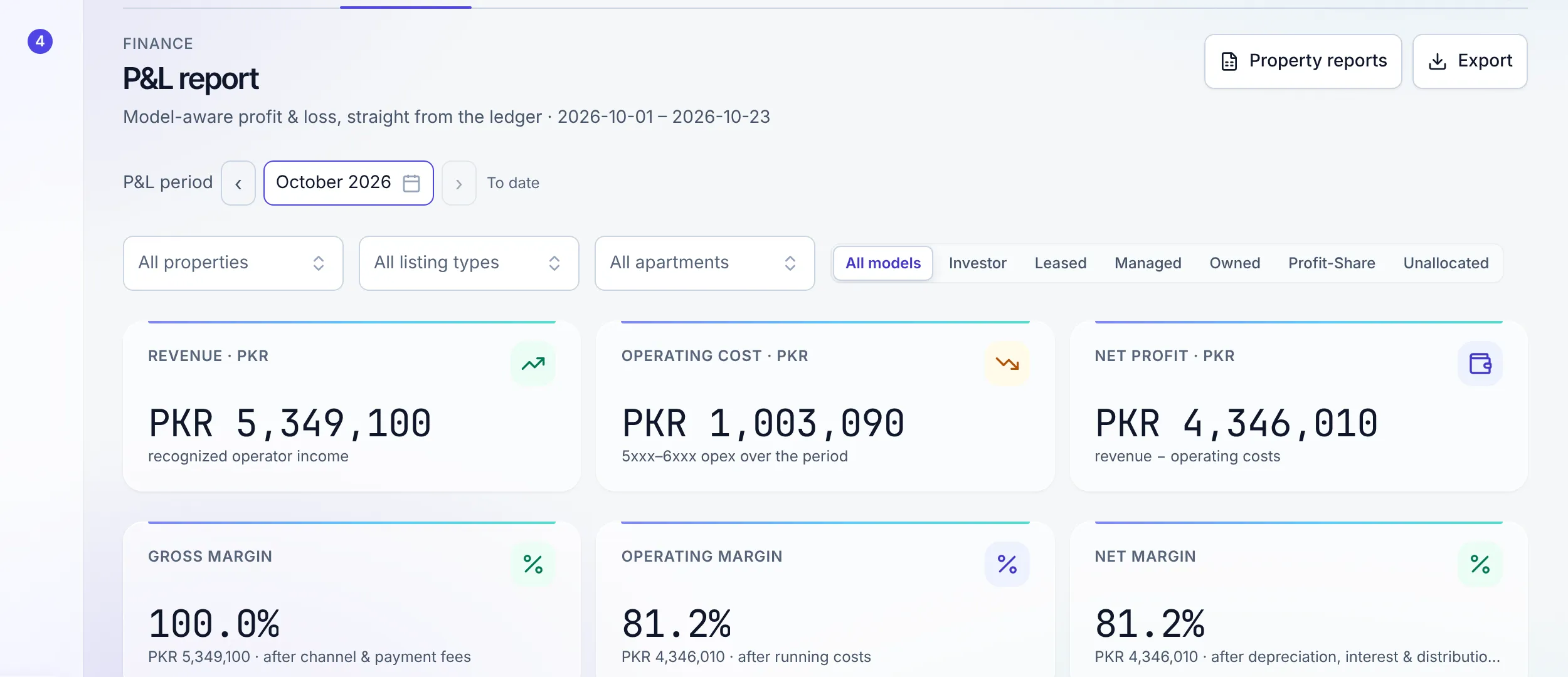
Owned, leased (arbitrage), profit share, managed for an owner, investor-funded: real portfolios mix all five, and the books have to know the difference. On a managed unit the gross is the owner's money and never your revenue, and the ledger enforces that isolation instead of trusting a formula in a spreadsheet.
This is not a roadmap slide. Our own production portfolio closed August 2026 on these books.
"An owner statement is a PDF. A ledger is proof."
Know your numbers
Which day of the month do you break even?
Stay n Host answers with a date: the Monthly break-even day, the day this month's revenue covered this month's costs, computed from the same ledger as everything else. Next to it sit ROI and break-even analysis per property, so "is this unit worth keeping" stops being a feeling and starts being a number.
Every report, explained →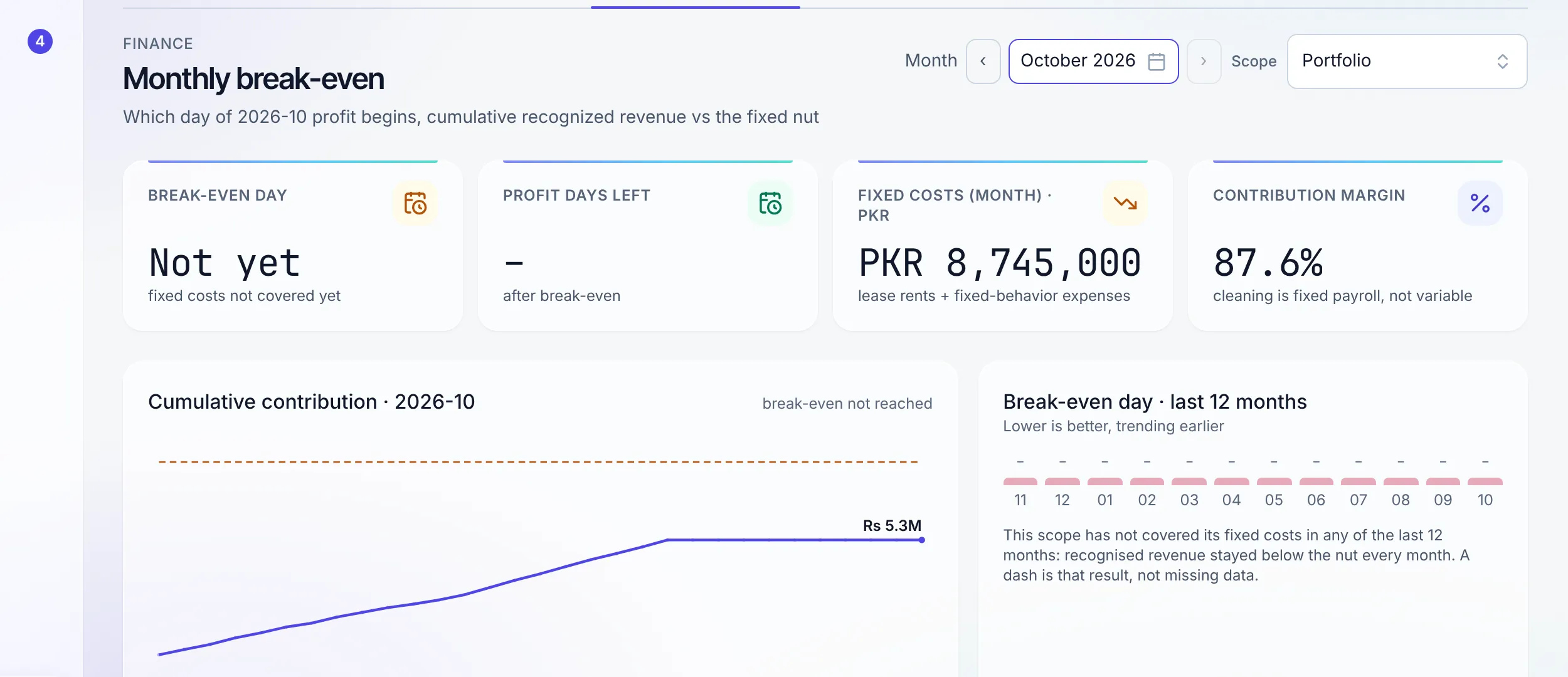
Close the month
A real period close, with accruals and a treasury ledger.
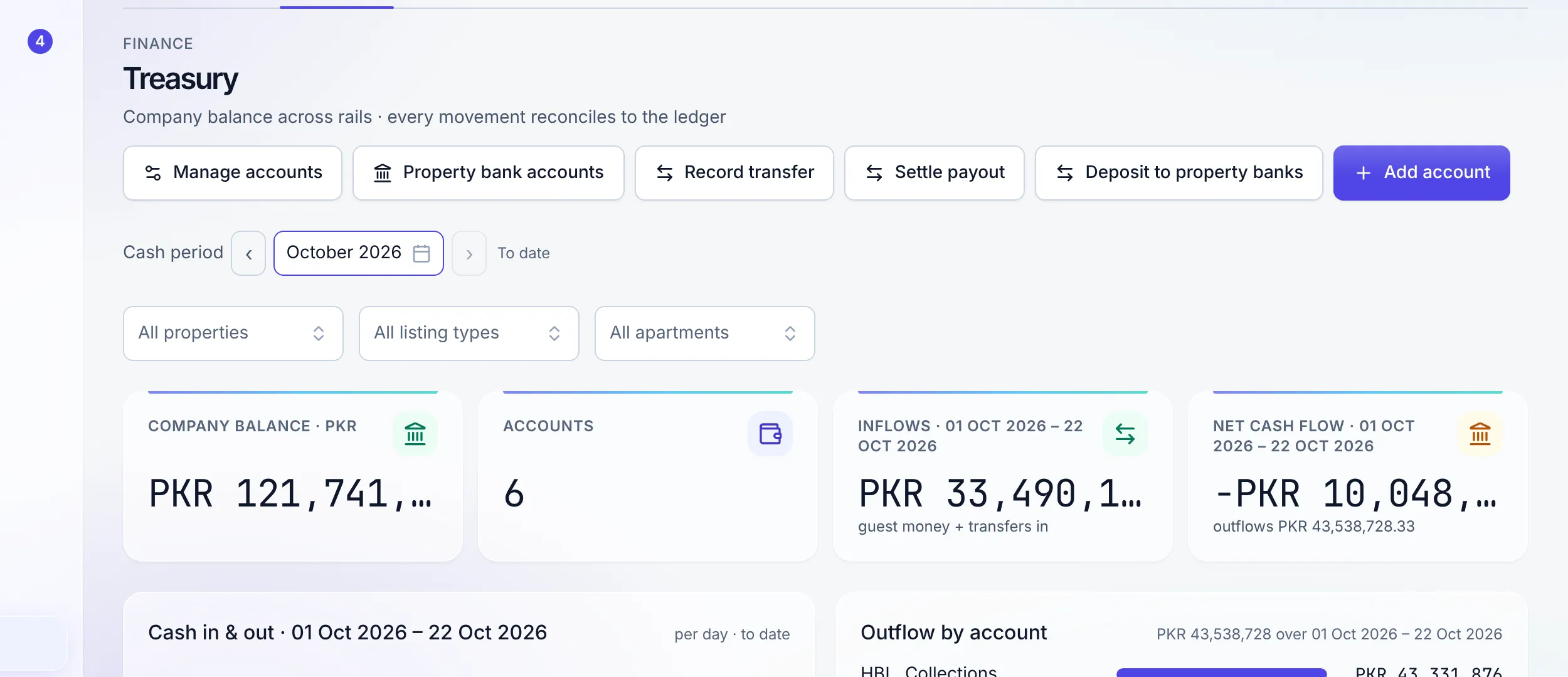
When the month ends, you close it: accruals posted, the period settled, and a treasury ledger showing where the cash actually sits, on the same books as the P&L. If you hold foreign currency, the close restates open foreign balances at the month-end rate you enter, posted to FX gain or loss. A posted ledger line cannot be edited, only reversed, which is what makes last month's numbers worth quoting to a bank, an owner, or an investor.
The whole finance picture
From nightly recognition to your accountant.
Night-based recognition
Revenue attaches to nights, not invoices: the check-in night counts, the check-out night does not, and month boundaries sort themselves out.
Occupancy, ADR, RevPAR
The operator metrics, computed from the same ledgered nights as the P&L, so the KPI and the books can never tell two different stories.
Per-property finance
Every unit answers for itself: its own P&L, ROI, and break-even, whatever its operating model.
Numbered journal entries
A gapless journal number on every posting, allocated by the database so two concurrent postings cannot claim the same one. It runs per book of account and resets each fiscal year, which is the shape an accountant expects.
Multi-currency
Hold money in more than one currency, convert between your own stores, book a channel's promise as a receivable that clears when the real payout lands, and revalue at month end.
Narrow it to one building
The P&L, payments, treasury, expenses and owner payouts all narrow by property, listing type or apartment, and a property-by-property income and expense report drills down to one apartment.
Every ledger page exports
Expenses, payments, treasury, payables, the P&L, the cash report and period-close accruals download as CSV, Excel or PDF, and the report builder answers any other question over 24 data sets.
Reports and exports →An accountant's own seat
Your accountant keeps their tools. They get a read-only seat, and the books leave as Xero or QuickBooks journal files with your account and tax mapping (Operator, or a $25 add-on), instead of a shoebox of screenshots.
See the plans →The full finance suite ships on Operator ($239/month) and Enterprise; finance essentials start on Growth ($79/month). Every price is public on the pricing page.
FAQ
Accounting questions
Is this real double-entry accounting or just pretty reports?
Real double-entry. Every verified payment posts balanced entries into a ledger that must reconcile to zero, and the reports are read straight off those books. There is no separate spreadsheet of "report numbers" that can drift from reality.
How does a payment become revenue?
Through a person. Guests pay by bank transfer or cash and upload proof. Someone on your team verifies each proof, and only then does the payment post to the ledger. Nothing becomes revenue until a human says so.
What operating models does the P&L understand?
Five: owned, leased (arbitrage), profit share, managed for an owner, and investor-funded. The books know the difference, and on a managed unit the gross is the owner’s money, never your revenue. The ledger enforces that isolation instead of trusting a formula.
When is revenue recognized?
Night by night. Each night of a stay carries its own revenue: the check-in night counts and the check-out night does not, so a stay that straddles two months lands in the right month automatically, without a manual adjustment.
Which plans include the accounting?
The full finance suite (model-aware P&L, ROI and break-even, period close, treasury) ships on Operator at $239/month and on Enterprise. Finance essentials start on Growth at $79/month, and the verified-payment and ledger workflow is on every plan.
Do I still need QuickBooks?
Your books live in Stay n Host, where every entry ties back to a booking, a night, and a verified payment. Your accountant gets a read-only External Accountant seat over the treasury, the ledger and the reports, so they can verify rather than re-key. They can also take files away: CSV, Excel and PDF on the ledger screens and from the report builder, and journal files for Xero and QuickBooks Online with your account and tax mapping (Operator, or a $25 add-on). That is an export you import, not a live two-way sync.
Try the whole platform free for 14 days
Full Growth-plan access. No credit card. Your data stays yours.
Start free trial