Investor-backed operators
Other people's capital deserves better than a deck and a promise.
If you raise to take on doors, three things decide whether you raise again: the record you can cite, the clarity of what you offered, and whether the reporting afterwards arrives without being chased. All three come out of the same ledger here.
Before the raise
A track record you did not have to write.
Freeze a set of figures from closed periods and cite them. Because they came out of the books rather than out of a spreadsheet made for the pitch, the same numbers are still there when a prospective investor asks their accountant to check.
Then model the pool: the units, the capital, the returns. The proposal you send is built from that model, and it expires, so an offer does not quietly stay open for six months.
Building a track record →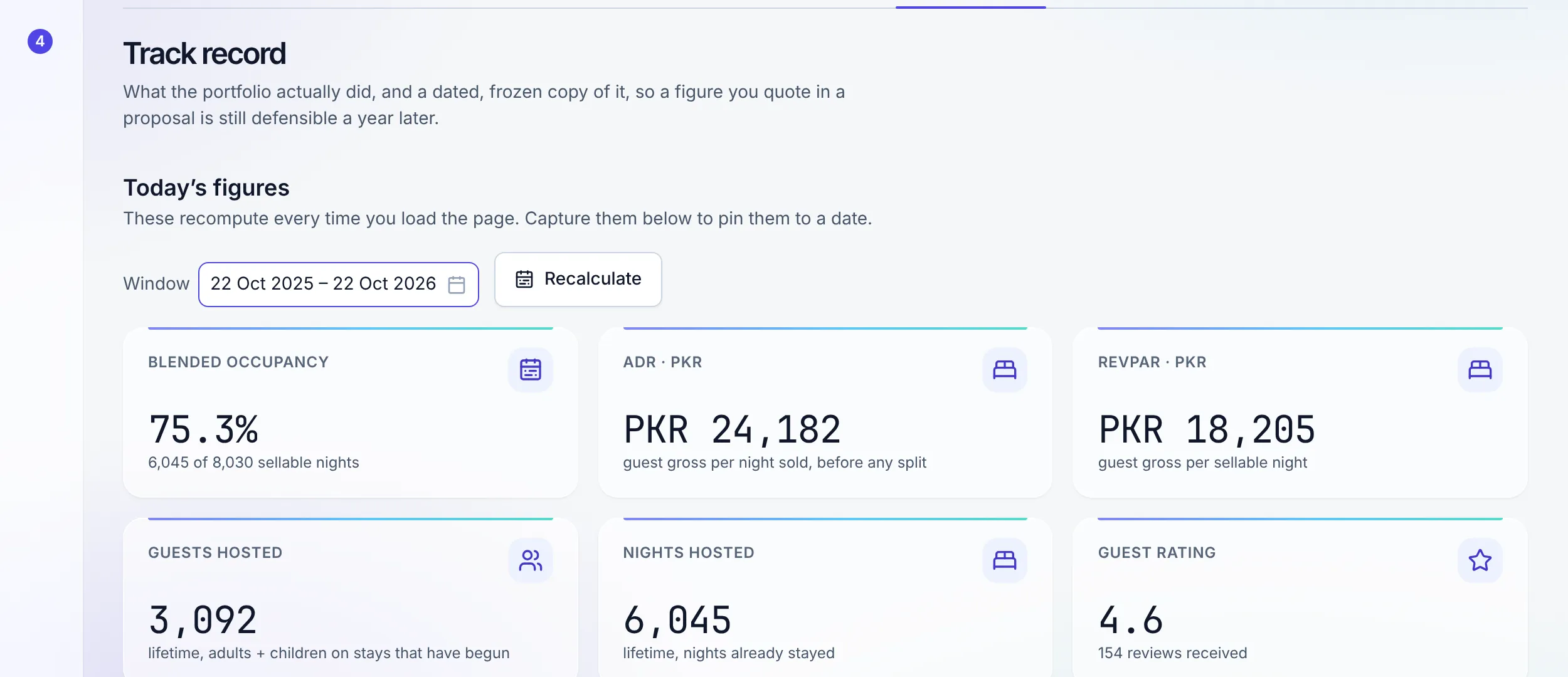
After the yes
Capital, deployed into named doors.
Money raised is recorded as a position, deployed against specific units, and the cost of getting those units earning is tracked as launch rather than smeared across operations. When a distribution goes out, it reduces the position instead of appearing as an expense.
That separation is the whole reason an investor-backed operator can still explain their operating margin two years in.
Investor-funded units in the books →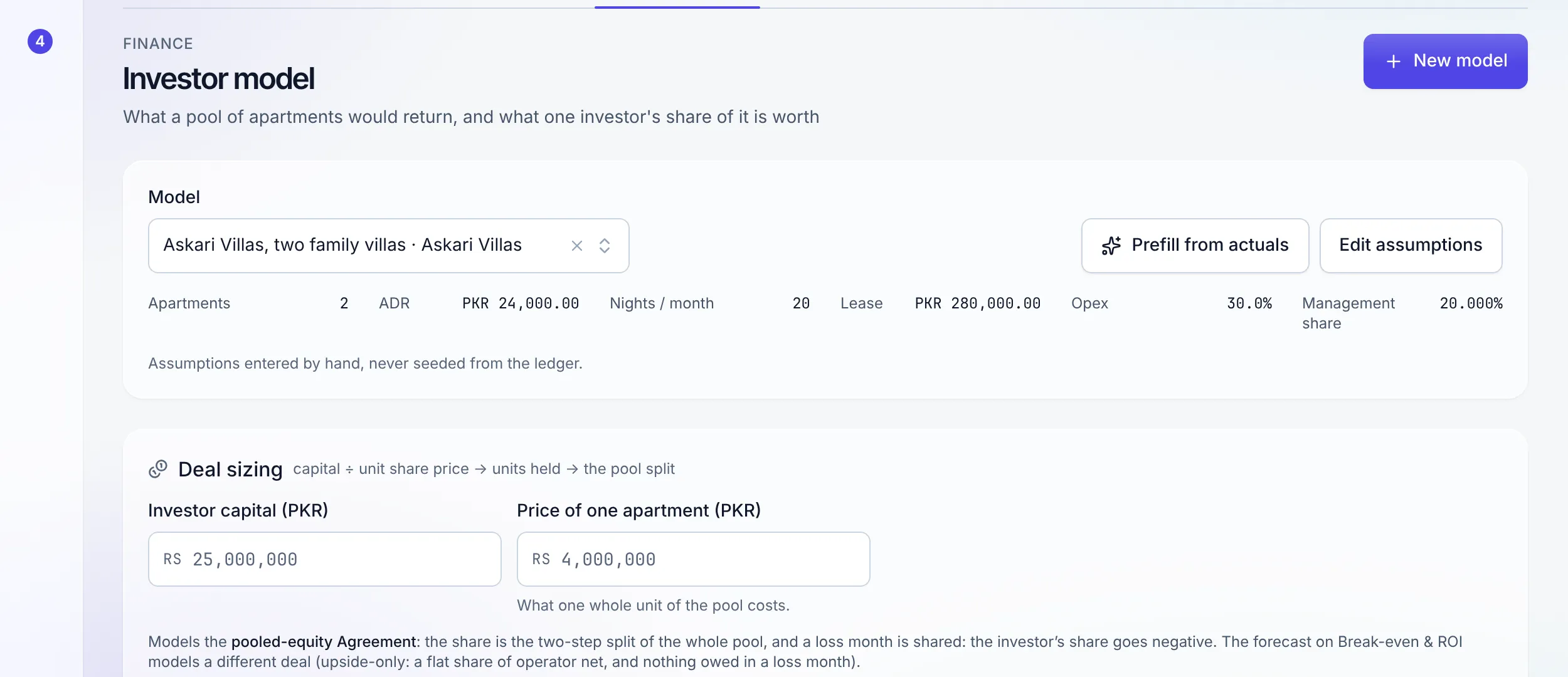
The relationship
Reporting that arrives without being asked for.
Their own portal
Each investor sees their position, their properties and their statements. Scoped in the database, not filtered in a page.
Statements from close
Produced when the month closes, from the same postings as your P&L, so the two can never diverge.
Distributions, recorded
Approved by a person, posted against the position, audited. No automation moves money, ever.
Owners kept separate
A property owner and a capital investor are different relationships with different books and different portals.
"The number in the deck should be the number in the ledger."
FAQ
Questions from investor-backed operators
What is a track record here?
A frozen, citable set of figures taken from closed periods. Because it is produced from the ledger rather than typed into a deck, the number you show an investor is the number your books will still say next quarter when they ask again.
Can I model a pool before raising it?
Yes. Model the pool, the units it would buy or fit out, and the returns it would produce, then send a proposal built from that model. Proposals expire, so an offer made in March is not still live in September.
How does capital reach a property?
Through deployment and launch. Capital is recorded, deployed against specific units, and the launch costs of getting a door earning are tracked as their own thing rather than blurred into operating costs.
Are investor distributions expenses?
No, and the books keep them apart. A distribution reduces what is owed to a position; it is not a cost of running the business. Treating the two as the same is how an investor-backed operation ends up unable to explain its own margin.
What do investors see?
Their own position and nothing else: capital recorded, distributions made, the properties their money is in, and their statements. Access is scoped in the database, so one investor cannot reach another’s position.
Is this the same as the owner portal?
No, deliberately. An owner owns a door; an investor holds a position in a pool. They have different statements, different portals and different accounting, because conflating them is what makes a cap table argument out of a bookkeeping question.
Try the whole platform free for 14 days
Full Growth-plan access. No credit card. Your data stays yours.
Start free trial