Reporting and analytics
Charts that came out of the ledger, not out of a second database.
Most rental dashboards are a separate analytics store fed by a pipeline, which is why the dashboard and the statement never quite match. Here a report is a view over the same double-entry postings, so there is nothing to reconcile because there is only one source.
The P&L
It knows which units are actually yours.
A rental portfolio is rarely one kind of thing. Some doors you own, some you lease, some you run for an owner, some you split profit on, some were bought with investor capital. Each one earns differently, and the P&L is built to know the difference rather than to average it away.
The consequence is unglamorous and enormous: your top line is your top line. Managed gross sits as owner liability, lease rent sits as the fixed cost it is, and the margin you read is the margin you have.
How the five models differ →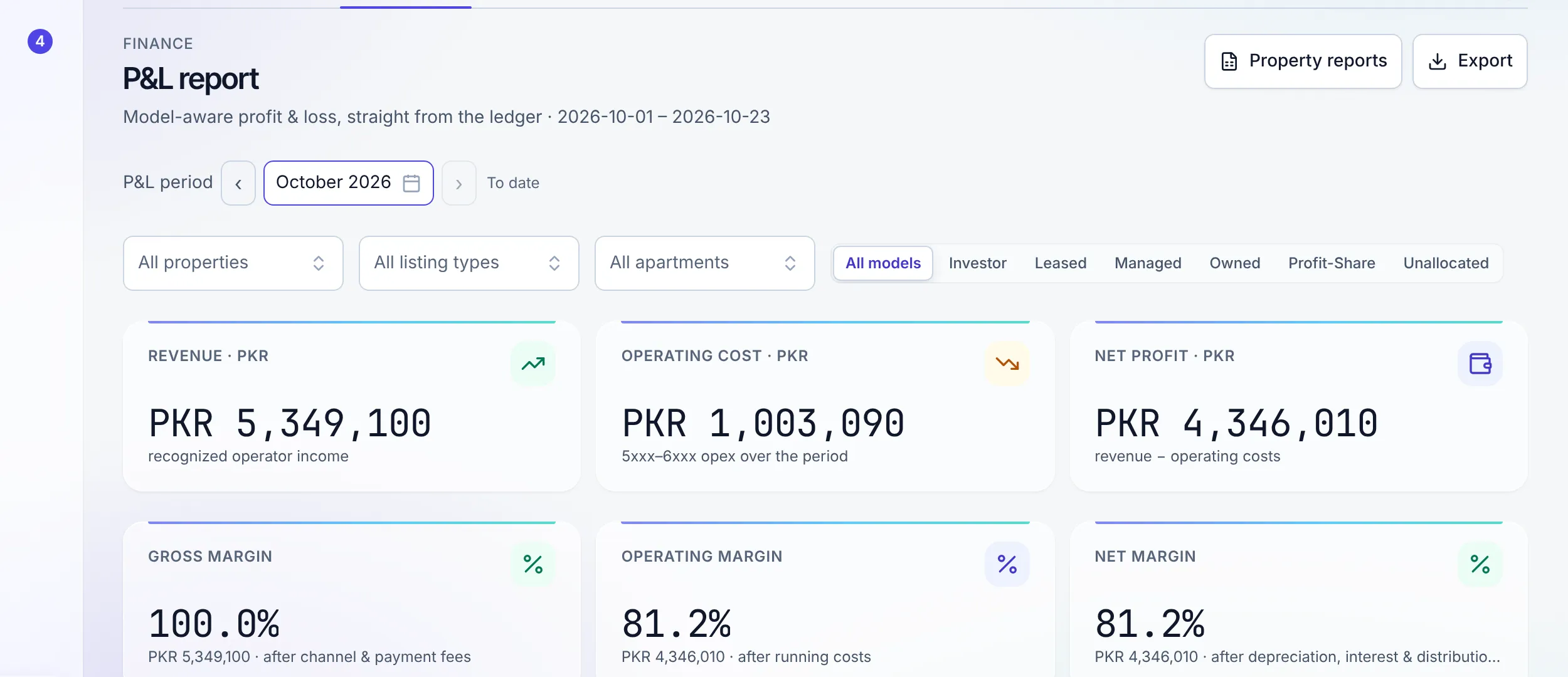
Break-even day
The date the month starts earning.
Fixed costs land whether or not anyone stays. Break-even day is the point in the month where recognized revenue has covered them, and it is the single most useful number an operator can carry in their head: before it you are paying for the month, after it you are earning from it.
Because revenue is recognized night by night, the line moves in real time as the month fills, rather than jumping when a payment happens to clear.
The break-even guide →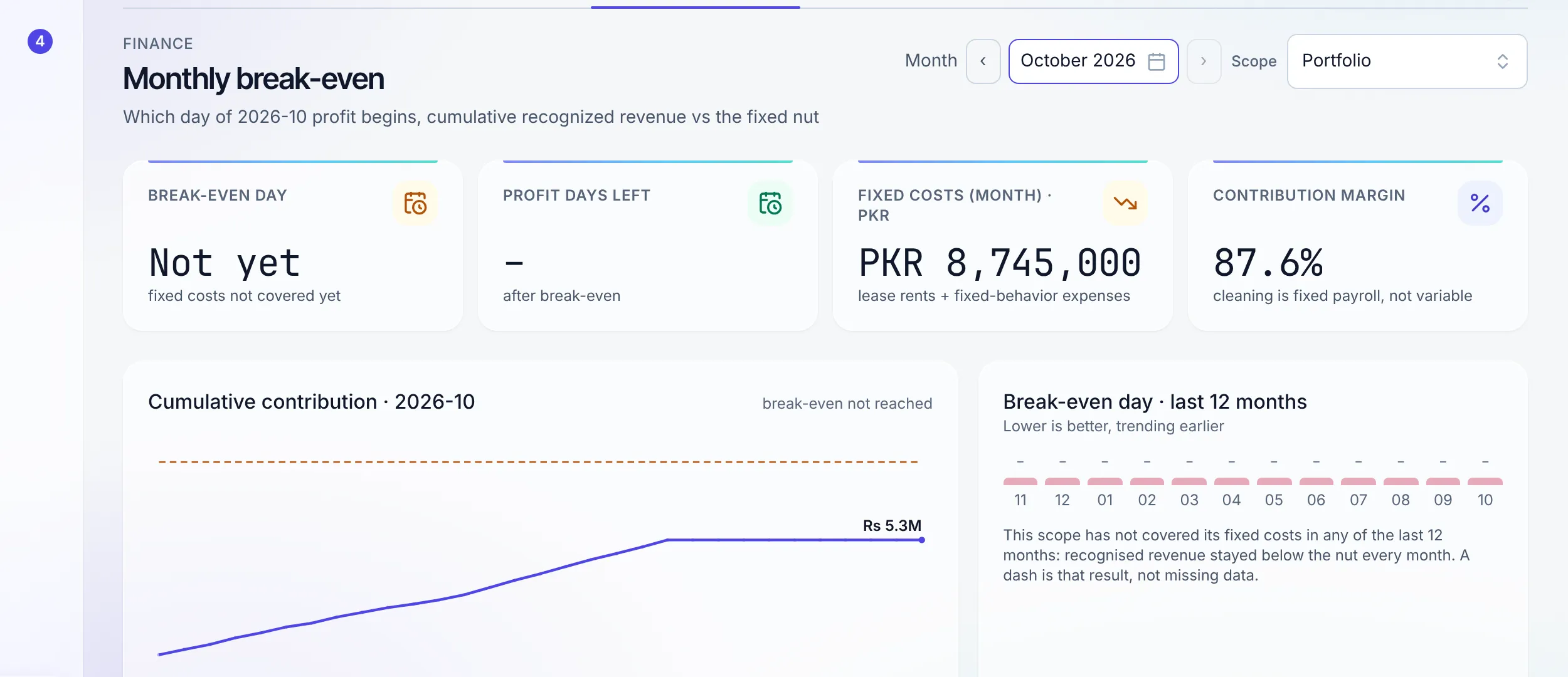
The rest of the numbers
What else you can read, and hand over.
Occupancy, ADR and RevPAR
Per property and per listing, over any period. Same night-level data as the revenue, so the two always describe the same nights.
The metric definitions →Cash report
What was collected against what was banked, reconciled. The check that matters in an operation where money is sometimes handed over at a door.
Period close
Close a month and it stops moving: owner statements are produced, the period is sealed, and later corrections are postings rather than quiet edits to history.
How close works →Exports for your accountant
A read-only External Accountant seat over the treasury, the ledger and every report, plus CSV, Excel and PDF on every ledger page and journal files for Xero and QuickBooks. Every posting carries a gapless journal number, per book of account, which is the reference an accountant will ask for.
Property by property
Income and expenses for each property, account line by account line, earned beside what is still to come. Click a row to drill down to one apartment and its entries, and export to Excel or PDF.
A report builder
Any other question, answered over 24 data sets with filters and grouped summaries, and exported to Excel or PDF. The rows follow the seat's own permissions.
Where inquiries drop off
The inquiry conversion funnel shows each stage from first message to booking, and every band opens the inquiries behind it.
What the booking site did
The booking site's Metrics tab follows requests through quote, payment and booking over a window you pick, beside the previous period, counted from the bookings themselves rather than from tracking.
Complimentary stays
What the workspace gave away, to whom, and on whose authority. A free night is a decision worth being able to count, and it has its own report and its own read permission.
"If the dashboard and the statement can disagree, one of them is decoration."
FAQ
Reporting questions
Where do the numbers come from?
The ledger, not a separate analytics store. Every report is a view over the same double-entry postings that produce owner statements and the period close, so a figure on a chart and a figure on a statement cannot disagree.
What is break-even day?
The day of the month when the revenue recognized so far covers the fixed costs of that month. It turns a P&L into an operating instinct: past that day the month is earning, before it the month is still paying for itself. It is computed per month from the same books.
How is revenue recognized?
Night by night across the stay, not in a lump on the booking date or the payment date. A stay that crosses a month boundary puts its nights in the months they actually happened, which is what makes a monthly P&L mean anything.
Does the P&L understand that some units are not mine?
Yes, and this is the part that is usually wrong elsewhere. The P&L is model-aware across owned, leased, profit-share, managed and investor-funded units. On a managed unit an owner’s gross is a liability rather than your revenue, so a portfolio of managed doors does not inflate your top line.
Can I get occupancy, ADR and RevPAR?
Yes, per property and per listing, over a period you choose. They come from the same night-level data as the revenue, so occupancy and revenue always describe the same nights.
Can my accountant have it?
Yes, by giving them a seat rather than a file. The External Accountant role is a read-only seat over the financial surfaces: the treasury and its full transaction ledger, the P&L, break-even, owner statements, occupancy and the tax rules. It cannot post, close a month or change a rate. They can take files too: CSV, Excel and PDF on the ledger screens, Excel and PDF from the report builder, and Xero or QuickBooks journal files (Operator, or a $25 add-on).
Can I build my own report?
Yes. The report builder works over 24 data sets, from bookings and booking nights to payments, channel payouts, audit events and agent runs, with filters and grouped summaries, and exports to Excel and PDF. The rows follow your own permissions, so a report never shows a seat what its screens would not.
Try the whole platform free for 14 days
Full Growth-plan access. No credit card. Your data stays yours.
Start free trial