Operating models
Five ways to run a door. Five different answers to "what did I earn".
Rental software almost always assumes you own everything you list. Real portfolios are mixed, and the mix is precisely where the money gets miscounted. Stay n Host makes the operating model a property-level fact that the ledger obeys.
Owned
The unit is yours.
Your revenue: The whole booking is your revenue.
Your costs: Your costs are the real ones: utilities, cleaning, maintenance, and the capital you tied up.
The part that bites
Depreciation and the asset register matter here in a way they do not on a leased door, which is why assets are tracked rather than assumed.
Leased
You rent the unit and sublet it, sometimes called rental arbitrage.
Your revenue: The whole booking is your revenue.
Your costs: Rent is a fixed cost that lands whether or not anybody stays, which is exactly why break-even day is the number that runs your month.
The part that bites
A lease override on a unit changes which costs apply to it. A one-table read of fees cannot see that override, so the resolution happens before anything is billed.
Managed
You run somebody else’s property for a fee.
Your revenue: Your management fee. Nothing else.
Your costs: The guest’s money is the owner’s from the moment it clears. It is a liability on your books, never operator income.
The part that bites
This is the row that inflates top lines everywhere else. Twenty managed doors should not make your revenue look like twenty owned doors.
Investor funded
Somebody else’s capital bought or fitted out the unit.
Your revenue: Your operating share, with the investor’s return accounted separately.
Your costs: Capital deployed, launch costs, and distributions each have their own place, so a distribution is not mistaken for an expense.
The part that bites
Investor positions have their own portal and their own statements, because capital is not the same thing as owning a door.
Where you set it
On the property, with its commercial terms.
The model lives on the property alongside the terms that govern it: the fee, the split, the rent, the owner it belongs to. Everything downstream reads it. The P&L groups by it, period close produces statements from it, break-even counts the right fixed costs because of it, and owner payouts post against the right liability.
Nobody has to remember which units are which at the end of the month, because the month already knows.
What the reports do with it →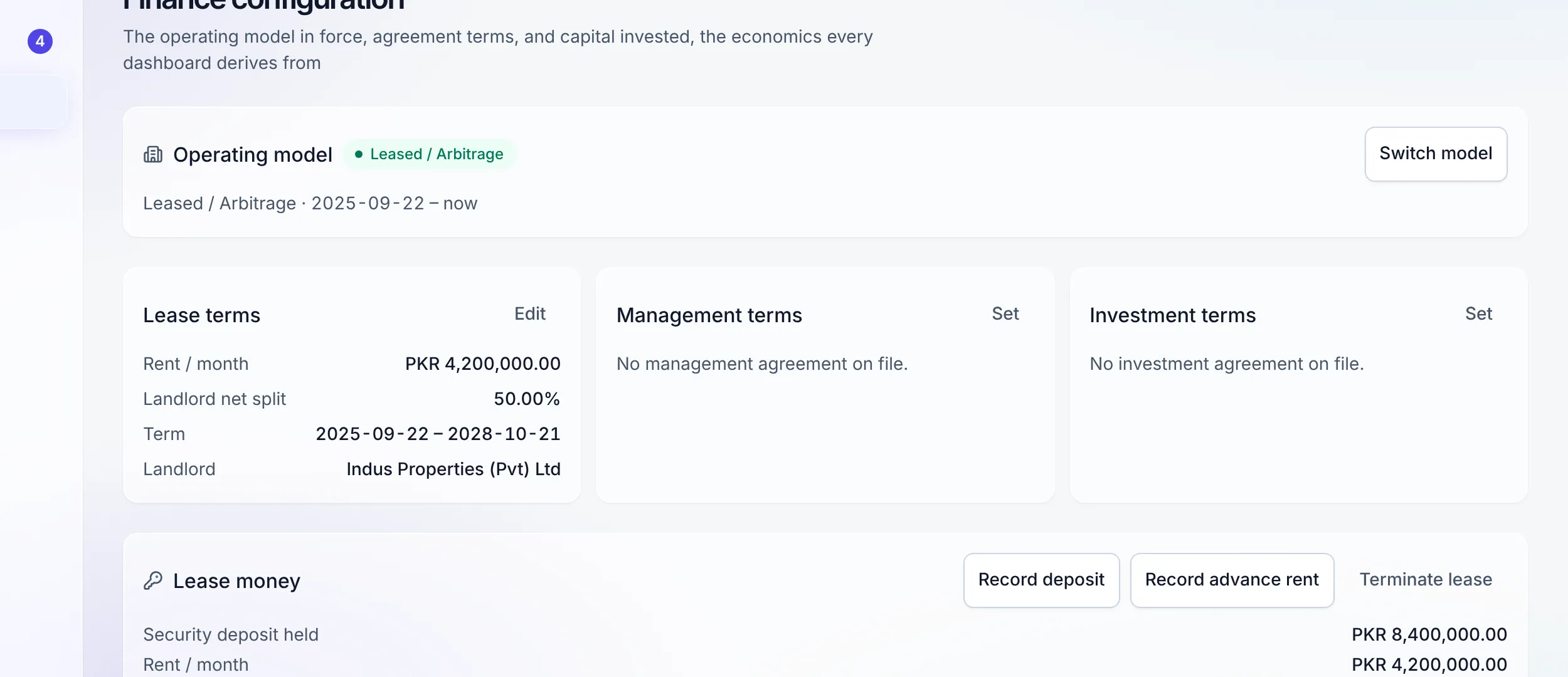
"Twenty managed doors should not make your revenue look like twenty owned doors."
FAQ
Operating model questions
Can one portfolio hold all five at once?
Yes, and most real portfolios do. The operating model is a property-level setting with its own commercial terms, so an owned flat, a leased apartment, and three doors you manage for an owner sit in the same workspace and each one is accounted for on its own terms.
Why does the model change the accounting rather than just the label?
Because the answer to "what is my revenue" is different on each one. On owned and leased units the booking is yours. On a managed unit only your fee is. On profit share it is your share after agreed costs. If software treats all of them as revenue, every downstream number, margin, break-even, tax, and the statement you send an owner, is wrong in the same direction.
Can I change a property’s model later?
Yes. It is a change to the property with an audit row, and it applies going forward. Closed periods stay as they were closed, which is the point of closing them.
Does the model affect what my team sees?
It affects who is entitled to what. A managed property has an owner with a portal seat; an investor-funded one has investor positions with their own. Both are scoped in the database so they see their own position and nothing else.
Try the whole platform free for 14 days
Full Growth-plan access. No credit card. Your data stays yours.
Start free trial