
AI-powered property management
AI-powered rental software that runs the whole operation.
One property or hundreds: guest messaging, Airbnb, Booking.com, Expedia, Agoda and Vrbo sync, cleaning, smart-lock door codes, direct bookings, a guest app for every stay, owner statements, and real accounting in one system. The AI drafts your guest replies and answers guest-app questions, checkout schedules the clean, and the agents release the door code through its gate, while you keep the keys to anything that moves money, closing the month included.
Core operations
The daily essentials, all in one place.
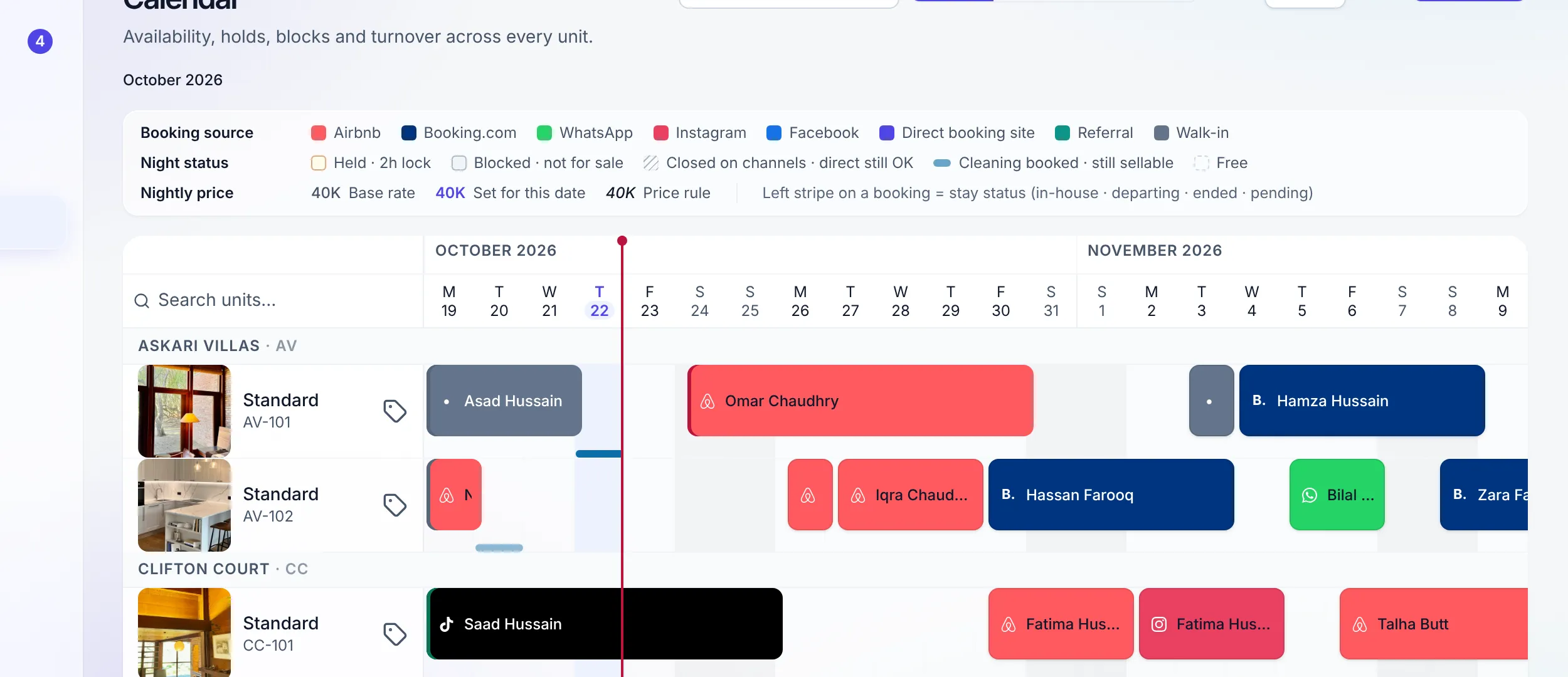
Every unit, every night, one board. Blocks, holds, linked units, and a structural guarantee that a night can only ever sell once, whichever channel sold it.
See the calendar →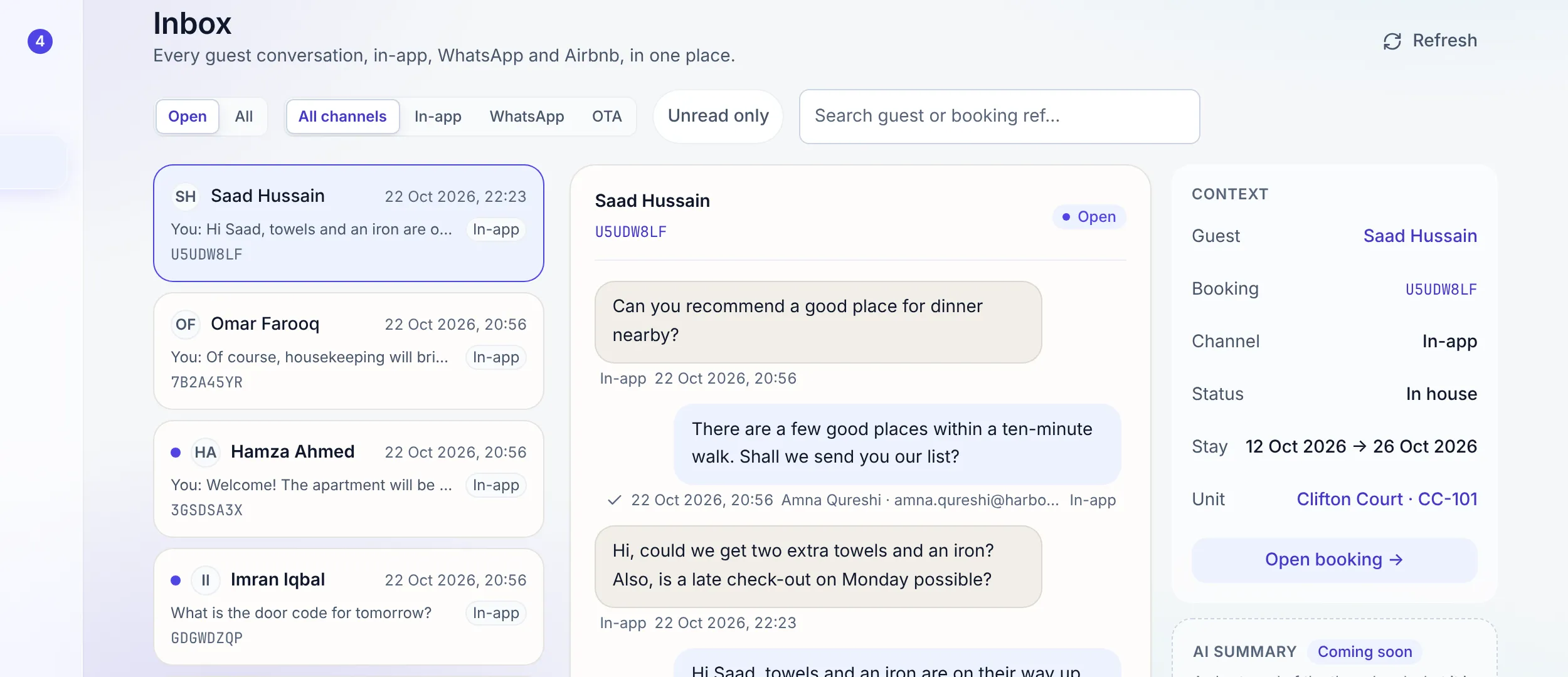
WhatsApp, Airbnb chat, and in-app messages in one shared inbox, with templates, internal notes, and automations that reply on time, every time.
See messaging →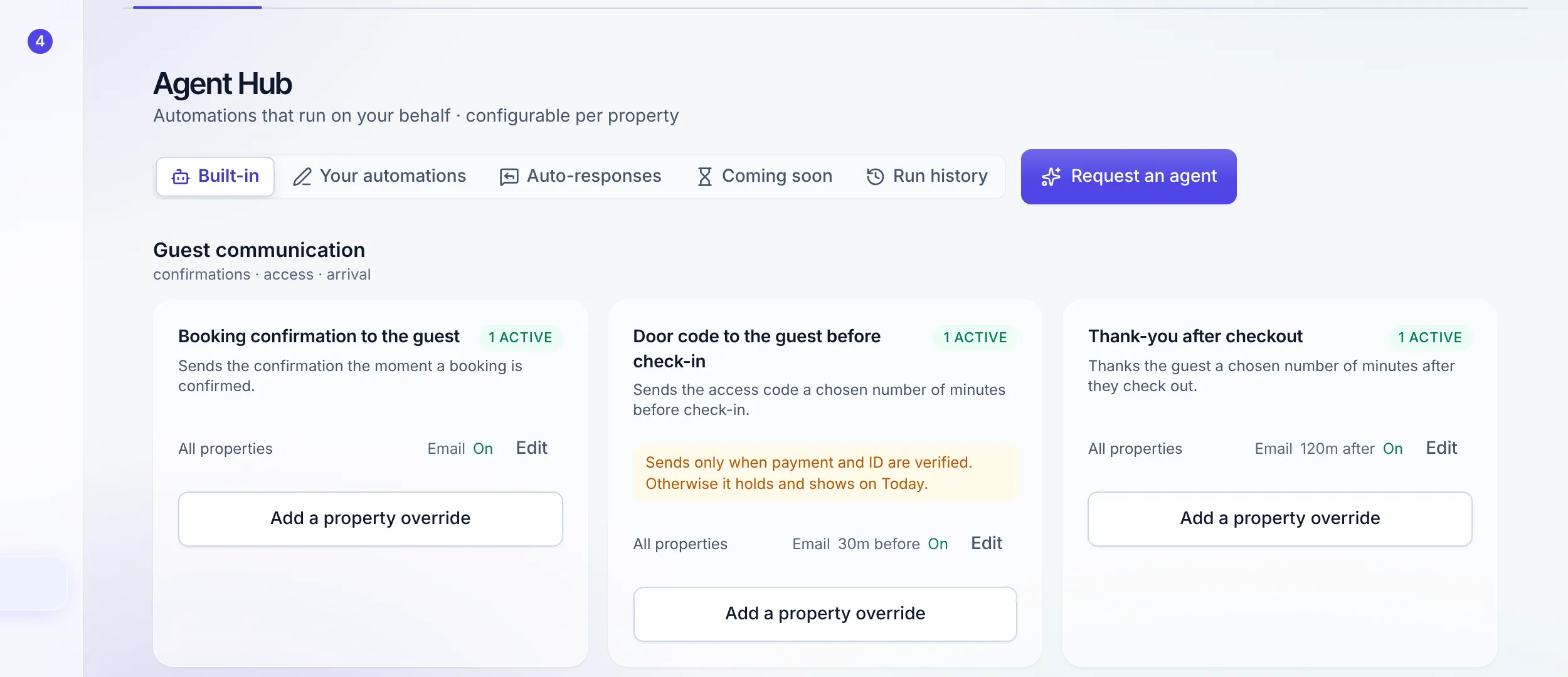
Eight built-ins: booking confirmation, door code before check-in, thank-you after checkout, unpaid-quote reminder, today's arrivals, same-day arrival alert, the daily ops report and AI replies. Add your own, all run by agents that never touch money.
Meet the agents →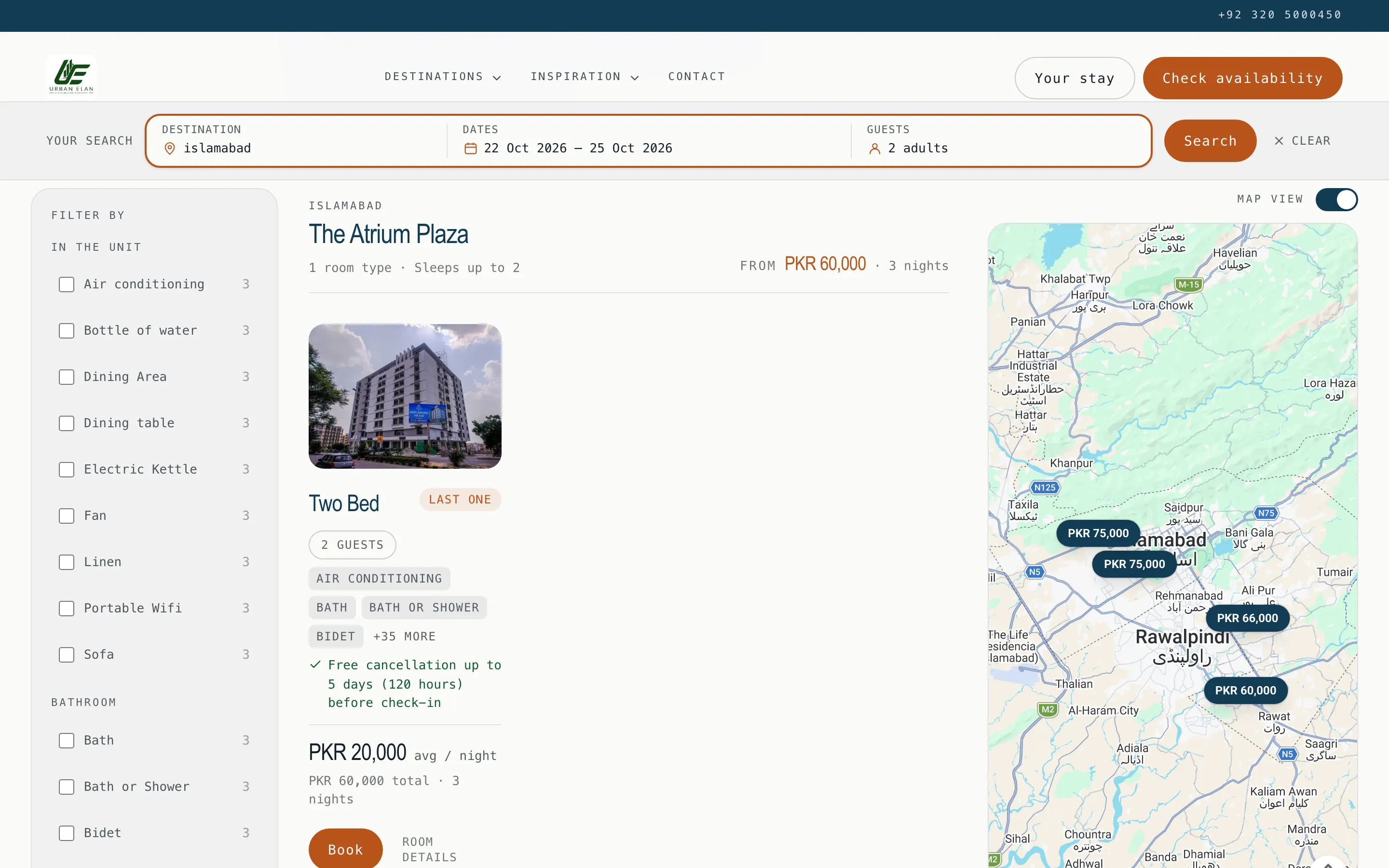
Your own commission-free website with live availability search, a map and amenity filters, plus no-login quote links for chat-negotiated bookings.
See direct booking →
Checkout fires the turnover: dispatch, clean with photo proof, inspect, ready. Cleaners get their own simple view.
See operations →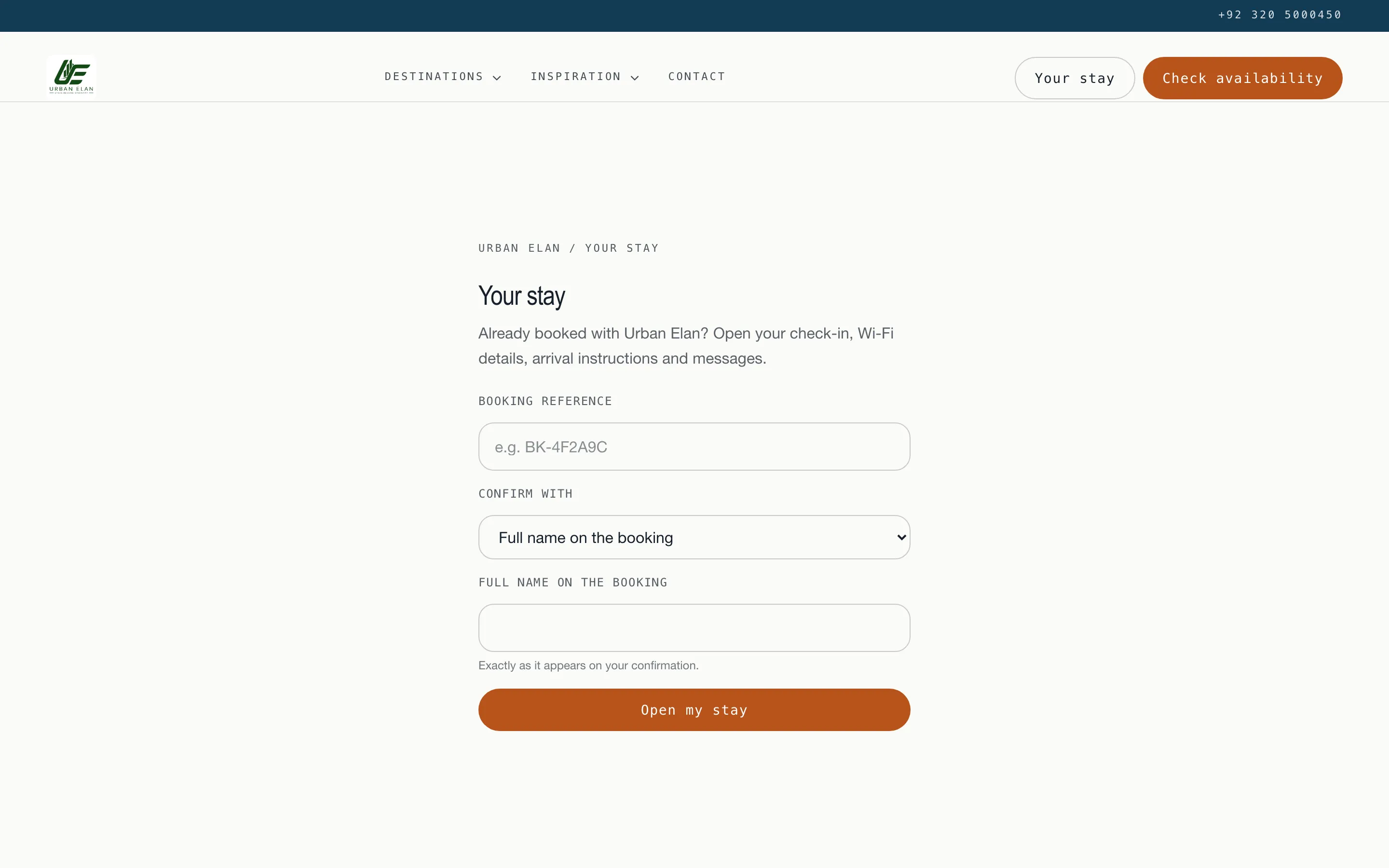
An in-stay app for check-in, door opening, Wi-Fi, and chat, with codes released only when payment and ID are both verified.
See the guest app →Your AI staff
While you slept, the system worked.
Agents do the repeatable work on time, every time, and write every action to the audit trail. This is a real night on a live portfolio.
The whole operation
One system, end to end.
WhatsApp-first guests
First message to confirmed booking without leaving the chat. Quote links, proof upload, one shared inbox.
Learn more →AI agents
Eight built-in automations plus your own, AI guest replies with a person on anything sensitive, dual-gated door codes. Never money.
Learn more →Real accounting
Double-entry ledger, five operating models, P&L, break-even day, period close, treasury.
Learn more →Owners and investors
Auto statements and payouts for owners. Pool modeling, track record, proposals, and a portal for investors.
Learn more →Every channel, one calendar
Airbnb, Booking.com, Expedia, Agoda, Vrbo and Google Vacation Rentals: availability, prices, bookings, messages and reviews, with a human gate on anything that changes money.
Learn more →Direct booking + guest app
Your own booking website, and an in-stay guest app: check-in wizard, door opening, Wi-Fi, chat.
Learn more →Books, not just bookings
Accounting that survives an audit, built in.
Every verified payment posts balanced, double-entry records. The P&L knows whether a unit is owned, leased, profit-share, managed, or investor-funded, and an owner's gross is never your revenue. Break-even day, period close, treasury: numbers a bank or a backer can read.
"An owner statement is a PDF. A ledger is proof."
How the books work →From the people running on it
Operators, in their own words.
Every review below names the person, the portfolio and the plan they run on.
Every platform sells you automated guest messaging and they all work about the same until something goes wrong. What sold me here is that an automation is not a special robot with its own powers - it calls the exact same operation a member of my staff would call, with the same permission check and the same gate. So an automated message can send a welcome note, and it structurally cannot release a door code past the verification gate or move a dollar, because a person in that seat could not either. Plus a run-history timeline that shows what fired, when, to whom, and whether it was delivered. I have saved probably fifteen hours a week and I have not once wondered what the system did behind my back.
My previous system had a channel manager that "synced". Twice a year it did not, and both times I paid for it in cancellation penalties and a wrecked review. In Stay n Host there is a single night-level inventory with a hard uniqueness constraint on unit-plus-night, and every source writes into it - Airbnb, our direct site, walk-in enquiries, even the temporary hold while a bank transfer is being verified. Nothing synchronises because there is nothing to synchronise. Fourteen months, forty thousand nights, zero oversells.
I have built a "direct booking website" on three different platforms and two of them were really just a nice page with an enquiry form. This one runs on my own domain, searches availability across all my properties at once, walks the guest from search to unit to request to a quote link, and takes the payment proof upload - and every step writes into the same inventory as my OTA bookings, so a direct booking physically cannot collide with an Airbnb one. Just over a quarter of my nights are direct now. The platform takes 2% of that channel and nothing at all on everything else.
Automatic access codes before arrival are table stakes now. What is not table stakes is what happens when the guest has not sent their ID. Everywhere else the code goes out anyway on a schedule, or the task silently fails and you find out when someone is locked out. Here the relay fires 30 minutes before check-in, but only if payment is verified and ID is verified, checked again at that exact instant - and if either is missing it holds, shows me the reason on my daily screen, and then sends by itself the moment I approve the document. Nobody has to be awake, and nothing goes out that should not.
Guests open a link, see their stay, and complete check-in for every person in the party - name, date of birth, nationality, document type and number, expiry, and a signature they draw with a finger. That is not a form that emails us a PDF: each guest becomes a verification item in the same queue our staff already work, so approving arrivals happens in one place. It also carries the WLAN password, arrival and parking directions, and our own information pages, and guests message us inside it on the same thread we see in our inbox. When they install it to their home screen it carries the property's mark, not the software vendor's logo, which for a white-labelled operation matters more than it sounds.
Most platforms mean "we send your cleaner a text" when they say cleaning automation. Here the checkout creates the job, the job is assigned, the cleaner opens a phone portal showing only her own jobs with same-day turnovers pinned at the top in red, and she works start, photos before, photos after, done. She cannot mark the unit ready - that queues an inspection for a different person. My phone stopped ringing forty times a day and my guests stopped walking into half-finished units. Same feature name as everyone else, completely different depth.
I came from a platform where the trust accounting was so hard to follow that we ran a separate accounting system beside it and reconciled the two monthly. Here the statement is generated from the ledger itself - gross, our management fee, the pass-through costs coded to the owner rather than to us, and the payout - so it ties out by construction. Owners have their own login and can see it without emailing me. We onboarded nine doors this year from an owner who left another manager specifically over statement disputes.
The thing I was most afraid of after reading reviews of other tools was the bill growing in ways I did not authorise - percentages of booking revenue, per-channel charges, add-ons discovered after onboarding. This is a flat monthly base plus a flat rate per property. Channels and bookings are never metered, and it takes nothing on my Airbnb bookings or deposits. What I did not expect on an entry plan is that the protections are all still there: the single calendar with no oversells, the hold while a payment is verified, ID before the door code, and the midnight summary. The advanced accounting sits on the bigger plans, which is fair - the things that prevent disasters do not.
Our previous system blocked the departure date, so across 47 units we were losing well over a hundred sellable nights a month that the calendar simply denied existed. Nights here are booked from arrival up to but not including departure, so the departure date is available the instant the booking is confirmed, and a same-day turnover is a supported case rather than a hack. The system flags those turnovers urgent automatically and works the cleaning deadline back from the next guest's actual check-in time for that specific unit. Our summer revenue was up meaningfully and our occupancy figure finally means what it says.
I moved because of a horror story I read and half-lived: a rushed setup on another platform, a double booking two weeks later, a cancellation penalty and a lost Superhost badge. What convinced me here was that the protection does not depend on me having understood the training. The oversell rule lives in the database, not in a checklist I was talked through once on a call. My onboarding session was also a real one - we mapped my eleven cottages, which I own versus manage, my check-in times per property, my cancellation rule, and who on my team is allowed to do what. I took bookings the same afternoon.
We always wanted more direct business and always got burned by it, because the direct calendar was a separate universe from the OTA calendar and someone had to keep them honest. Now the direct site is just another writer into the same inventory, so the risk that stopped us growing it is gone. Corporate clients book through it, the quote link handles negotiated rates, and their transfer proof uploads straight into the verification queue. About 35% of nights are direct at a fraction of the OTA commission, and the platform's own cut applies only to that one channel.
Obvious in hindsight, missing everywhere I have worked. Each unit has a guest code and a distinct cleaner code. The cleaner's code releases when the cleaning job is assigned - gated on the assignment, not on the guest's paperwork - so housekeeping is never blocked by a slow document approval, and no guest ever receives the code my staff use. When we have had a difficult guest the system raises an advisory to consider changing the code rather than pretending it can undo what someone already knows, which I found refreshingly honest for software.
On my old stack these were a WhatsApp negotiation and, if I remembered, a cash note. Here the guest asks, the point of contact approves, the extra charge is quoted and taken, and the booking, the calendar, the cleaning deadline and the ledger all move together. Extensions work the same way and are the one place the system allows a partial payment, which happens to be exactly our policy. It is the first time these upsells have shown up as a line in my P&L rather than as goodwill I gave away.
Airbnb messages, direct enquiries, WhatsApp and now the guest app all land in one conversation per guest with the booking context beside it. My team stopped alt-tabbing between four apps and our response time halved. Internal notes stay internal and are never exposed on the guest side, which I specifically tested before rolling it out because I have been burned by that before. Review requests go out automatically after checkout when there has been no incident, and to a Google review link for our direct guests.
I imported four years of bookings including stays that were in progress on the day of import. Each one landed in the right status - completed, in house, arriving - worked out from the dates rather than from me telling it. Where two of my old exports disagreed about the same night, those rows went into a quarantine list for me to resolve instead of being imported into a double booking. Twenty-three rows needed a human. I would far rather have met them during migration than in front of a guest.
Most STR reporting stops at revenue and occupancy. I need to know whether unit 1204 covers its own rent, what my payback is on the fit-out, and what my margin is once the owners' share is out. The P&L is aware of how each property is held - owned, leased, managed, profit-share, investor-funded - and reports each on its own terms, with break-even occupancy and break-even nightly rate on the leased ones and cap rate and cash-on-cash on the owned. Underneath it is a real double-entry ledger that has to balance, not a categorised transaction list. My board pack comes out of the software now.
I manage fourteen of my twenty-three units for other owners. On a percentage-of-revenue platform I was paying a cut of gross guest money of which I keep 20% - the maths gets ugly fast and it punished me for growing the managed side. Flat per property per month, nothing on bookings, nothing on deposits, nothing on owner payouts. My software cost became a number I can put in a forecast, and my managed portfolio became worth growing again.
The reason I left my last platform was not a missing feature, it was waiting four days for a reply about a booking that had gone wrong. Here I have a named contact, replies come back the same day, and - the part I did not expect - when something is not built yet they say so rather than describing a roadmap as if it shipped. I was told plainly that one thing I asked for is not there. I would rather have that than discover it myself in week three.
Between the guest app and the timed code relay, a standard arrival now involves nobody from my team. The guest checks in on their phone before travelling, the documents hit our verification queue during working hours, and the code goes out half an hour before check-in on its own. Our exceptions - the ones that actually need a person - are the only things on our arrivals list now, and they are on it with the reason attached. My staff cost per arrival is down by more than half.
We flip half the portfolio on a Saturday in season and take bookings on four channels plus our own site. The thing that used to break was always the same: two systems believing different things about one night. There is one night table here with a database-level guarantee, and every turnover is flagged urgent automatically with a deadline derived from the next guest's real check-in time for that specific unit. First March in six years with no cancellation, no apology email and no relocation.
Booking, then the app with their stay and directions and WLAN, then self check-in with documents, then the code arriving before they land, then in-app messaging if they need us, then the checkout reminder and the review request. Each of those existed somewhere in my old stack, in three different tools that did not know about each other, and I was the integration. Now it is one journey on one record, and the upsells - early check-in, late checkout - sit inside it as real charges rather than favours.
I did not expect the direct site to be worth it at my size. It runs on my domain, it searches across all six apartments, it looks like it belongs to my business rather than to a software vendor, and the enquiries land in the same inbox and inventory as everything else. It has taken enough direct nights in four months to cover the whole subscription and then some. And because it writes into the same calendar, it added a channel without adding a risk.
Before and after photos on every clean, timestamped and attached to the unit and the booking, and damage recorded with its own evidence. Our external cleaning company challenged two charges and the record settled both - once in their favour, which mattered for the relationship. When a guest disputed a damage claim we produced a timestamped sequence in minutes. My team's standard went up simply because the work is visible, and nobody has complained about being photographed because they can see it protects them too.
I manage a mix: some owned, some head-leased, most managed for third parties, one block investor-funded. Every previous system let me report all of that as one revenue number, which felt great and was meaningless. This one posts managed guest revenue to an owner liability and will only recognise my fee as income; investor capital is a liability, not my money; and rollups join every night to whichever model was in force on that night, so changing a property's model does not rewrite last year. My reported revenue dropped by a third when we switched. It was the first honest number I had ever had.
Rate suggestions come with the reasoning - booking pace, day of week, what is still unsold for that date - and nothing changes a live rate until I accept it, because pricing is on the human-approval list by default. I take about four in five. The other one in five is where I know something the model does not: a trade fair, a road closure, a corporate block I am holding. Combined with occupancy and ADR computed on a correct night base, and RevPAR that excludes managed gross from my operator numbers, it is the first pricing tool I have used where I trust both the suggestion and the measurement of whether it worked.
I spent two months trialling the market leaders. Reviewers rave about the booking engine, the card checkout, the instant payouts. Not one of those works here: my guests send a bank transfer, an Easypaisa payment or a JazzCash screenshot, and there is no card on file to charge. Every one of those platforms made me work around it with a fake "cash" booking that broke the accounting. Stay n Host treats the transfer proof as the normal path - upload, the unit goes on hold for two hours, my accounts manager verifies against the real statement, then it confirms. My treasury shows bank, Easypaisa, JazzCash and cash as separate accounts with their own balances. It is the first system built for the way money actually moves in Pakistan rather than the way it moves in California. Two months of trials, and this was the only one I did not have to fight.
Our compliance is not optional and it is not generic. Local guests: CNIC front, back and number. Foreign guests: passport. A couple whose CNIC addresses do not match: marriage certificate. On the international platforms I was pasting these into a "notes" field and hoping. Here they are proper verification items with their own queue, the documents are stored encrypted, access is logged, and the door code physically cannot be relayed until the ID is approved alongside the payment. When the authorities asked for our records I exported them the same morning instead of rebuilding them from three WhatsApp groups. For anyone operating under real ID rules here, this alone is worth the switch.
Forty of my sixty-three units belong to other people and I take a percentage of net. The international tools all report my gross guest revenue as my revenue, which flatters me by a factor of four and is simply false. Stay n Host posts that gross to an owner-payable liability and recognises only my management fee as income - there is no route in the software for it to become my profit even if I wanted it to. Owners have their own portal and the statement reconciles because it comes out of the ledger. Two owners moved their buildings to me this year after seeing the statement.
We ran the business out of a WhatsApp group: arrivals, cleanings, payment screenshots, complaints, all scrolling past each other at 2am. At midnight now each manager gets their own message - arrivals, departures, urgent same-day turnovers, in-house, what is still sellable tonight, payments and CNICs waiting on verification, codes held, cleanings, inspections, damage follow-ups. Per person, not per group, so nobody can claim they missed it. Our morning meeting went from forty minutes of reconstructing yesterday to ten minutes of decisions, and the group is now only for things that are actually urgent. My managers ask for this report on their days off, which tells you everything.
Small operator here, and my worry with any foreign software was the bill: a dollar price, a rupee bank account, and a monthly disagreement about the exchange rate. Stay n Host prices in USD but the invoice records the rate at the moment my receipt is verified and stores it on the invoice, so what I owe in rupees is fixed and written down rather than recalculated later. Paying by bank transfer is a supported path, not an exception I had to negotiate. On the guest-facing side the same idea holds - flat monthly per property, nothing taken from my Airbnb bookings or my walk-in guests. At nine units I know exactly what next year costs, to the rupee. No surprises is a feature, and nobody else offered it.
My team does not read English well and I was dreading the rollout. I did not need to. They open a link on their phone, see only their own jobs for the day with the urgent same-day turnovers pinned at the top in red, and the whole flow is start, photos before, photos after, done. Nobody needed training twice. The part I love most is that a cleaner cannot mark a unit ready - she completes it, that queues an inspection, and I or an inspector clear it. Guests walking into half-cleaned apartments used to be my recurring nightmare and it has not happened once since we switched. Genuinely the best operational change we have made in five years.
Somebody sends a payment screenshot, accounts takes half an hour to check it against the statement, and in that gap another agent sells the same apartment. That was our life. Every week there was an argument and roughly twice a month an apology to a guest. In Stay n Host the second the proof is uploaded that exact unit goes on a two-hour hold and disappears from availability for everyone - before anyone has verified anything - and if the money never lands the hold expires by itself and the night goes back on sale. Zero double-sells since we started. I did not expect a single feature to change the mood in an office, but it did.
We take Airbnb, corporate, and a lot of walk-in business, and keeping those in one honest calendar was a daily manual job that failed often enough to hurt. There is one night table here with a hard database rule of one booking per unit per night, and Airbnb, offline enquiries, our direct site and even the temporary holds all write into it. Nothing syncs because nothing needs to. On top of that the checkout date is not blocked - nights run from arrival up to but not including departure - so we recovered a genuinely surprising number of sellable nights across 27 units. Two problems I had assumed were permanent, both gone.
I had four apartments I bought, six I rent and sublet, and two funded by a family investor, all reported as one lump of revenue in my spreadsheet. This is the first system that treats them as three different businesses, because they are. The leased ones show break-even occupancy and break-even nightly rate against the actual rent. The owned ones show payback and cash-on-cash. The investor's capital sits as a liability, not as my money, and only my agreed share is income. Two of my leased units turned out to have been underwater since last winter. That was not pleasant reading and it is exactly why I rate this five stars.
My job used to be judging, alone and half asleep, whether a guest messaging at 1am had really paid and really sent their CNIC. Get it wrong and it is my name on it. Stay n Host took that decision away from me entirely: the access code relays half an hour before check-in on its own, but only if the payment is verified and the ID is verified, checked again at that exact instant - and if either is missing the send holds and shows the reason instead of going out or silently failing. The moment the document is approved it sends by itself. Guests now let themselves in on a normal arrival and I only handle the genuine exceptions. My nights have changed completely.
Your day, one screen
Home: arrivals, turnovers, and everything waiting on you.
Every morning starts on Home: Waiting on you, the queue of exactly what a human must decide, then an arrivals checklist and live turnover status. Cleaners and inspectors get their own self-scoped views. You hire for the work, not for the coordination.
Take the product tour →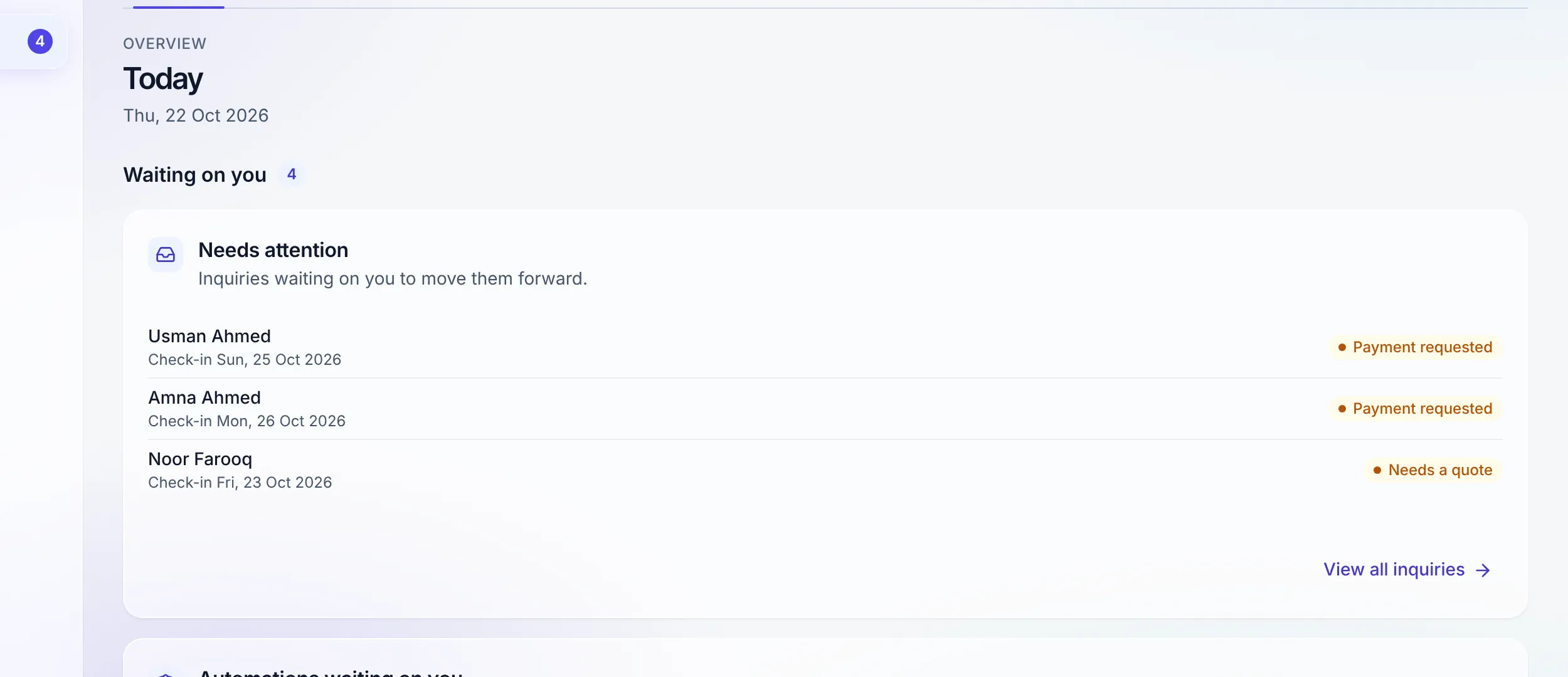
Don't take our word for it
Ask your AI about us.
Paste this into ChatGPT, Claude, or Perplexity. We publish our prices and our limits, so the answer will be accurate.
Opens in a new tab with the prompt already in the box. Gemini cannot take a prompt from a link, so that one lands on the clipboard for you to paste.
FAQ
Questions, answered
How much does Stay n Host cost in 2026?
All five prices are public: Solo $15/month (1 property), Starter $29 (3 properties), Growth $79 (5 properties), Operator $239 (10 properties, owner seats included), Enterprise custom. Annual billing is cheaper, for example Solo $13 and Growth $69 per month. Every tier starts with a 14-day free trial, no credit card.
How do guests pay?
The way most guests outside card-first markets actually pay: bank transfer and cash, as first-class rails rather than a fallback. A guest gets a no-login quote link with your bank details, uploads proof of payment, and a person on your team verifies it before any money posts to the books. Card payment is not available yet and is on the roadmap.
Does Stay n Host really work over WhatsApp?
Yes, and deeper than reservation messaging. A guest's first WhatsApp message automatically opens an inquiry with the chat attached. Your team replies from one shared inbox, automations send confirmations and door codes on your number (falling back to email outside WhatsApp's 24-hour window if you have no approved template), and the nightly ops report reaches your team on WhatsApp too.
What makes the accounting different from owner statements?
An owner statement is a PDF. Stay n Host keeps real double-entry books that reconcile to zero, knows whether each unit is owned, leased, profit-share, managed, or investor-funded, and produces a model-aware P&L, break-even day, and a proper period close.
Can AI agents run my operation on their own?
Agents handle the repeatable work: eight built-in automations (booking confirmations, door codes, thank-you notes, unpaid-quote reminders, arrival digests, the nightly report and AI replies) plus the ones you write, with door codes released only when payment and ID are both verified, re-checked at send time. AI guest replies, an add-on, draft answers from your property facts and can auto-answer guest-app questions, while money, refunds, discounts, cancellations, complaints and door codes always wait for a person. One hard limit makes the rest trustworthy: no agent can move money. Ever.
Can I bring my existing bookings?
Yes. The import tool takes your history and future bookings from a spreadsheet: upload, map columns, preview every row, then commit, with rollback if you change your mind.
Try the whole platform free for 14 days
Full Growth-plan access. No credit card. Your data stays yours.
Start free trial