Rental arbitrage
You pay the rent before you earn it. Your software should say when that flips.
Occupancy is a vanity number when the rent is already gone. What matters is the day of the month your recognized revenue covered your fixed costs, per door and across the portfolio. That day has a name here, and it is on the screen.
Break-even day
The date the month starts being yours.
Before it, every night sold is paying the landlord. After it, every night sold is margin. Because revenue is recognized night by night rather than on the booking date or the payment date, the line moves in real time as the month fills.
It is the only number that turns a P&L into an instinct, and it is the first thing an arbitrage operator should look at on the 12th.
How break-even is computed →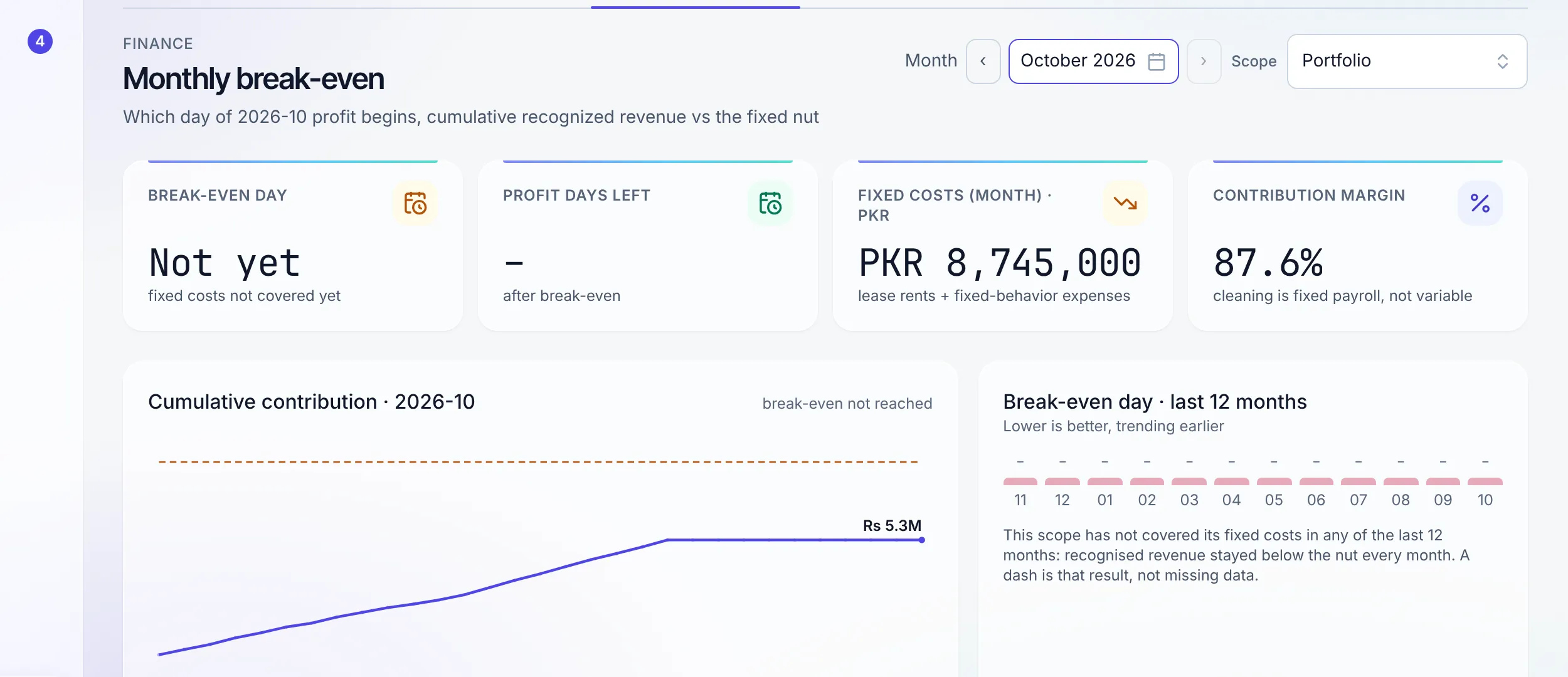
Per door
Which unit is quietly losing money.
A leased door and an owned door are different businesses, and the P&L knows it. Rent lands against the unit that owes it, so a property that looked fine inside a portfolio average shows up as the one dragging the month down.
When a lease carries unusual terms, the override is resolved before anything is billed against that unit, which is the difference between a fee schedule that is roughly right and one that is right.
Owned versus leased in the books →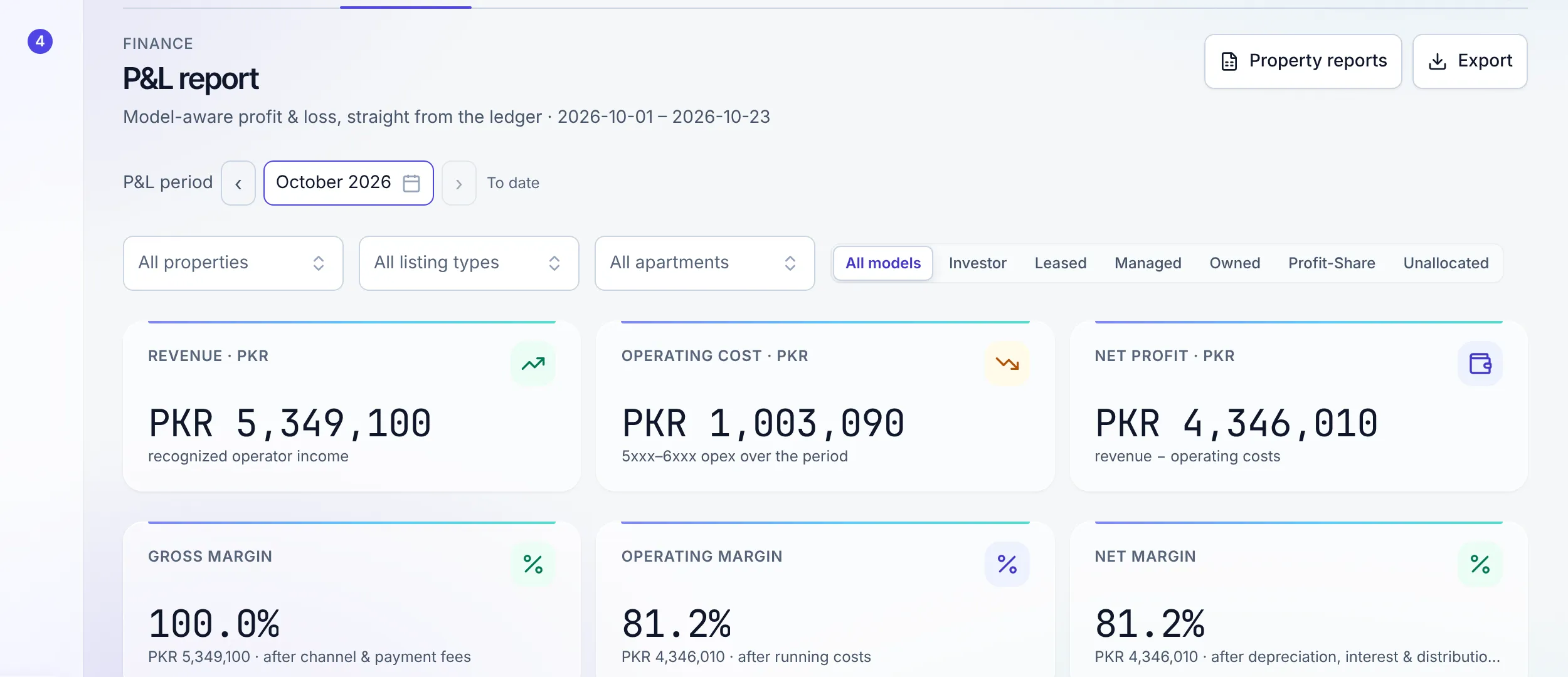
The rest of the month
Everything that is not the spreadsheet.
Rent as a payable
Rent, utilities, cleaning and payroll all sit in one payables calendar, posted to the ledger. The landlord side stops being a separate document.
The payables calendar →Direct bookings without commission
Your own booking site and quote links, so the margin you fought for is not handed straight back to a channel.
Direct booking →Every night on more channels
Airbnb, Booking.com, Expedia, Agoda, Vrbo and Google Vacation Rentals from one calendar that sells each night once, with each channel's fees booked as bills so the margin you see is the margin you keep.
Channels →Prices that follow your rules
Weekend, season, length-of-stay, last-minute, early-bird, occupancy and pace rules with a floor under every night, previewed before they apply (Enterprise, or a $9 add-on). Or let the pricing tool you already use own the rate.
Pricing and add-ons →Turnovers you can prove
Photo-evidenced inspections attach to the stay, which is what makes a deposit or damage conversation with a guest survivable.
Field operations →Books an investor can read
When you raise to take on more units, the track record you cite comes out of the same closed periods rather than out of a deck.
The investor suite →"Occupancy is a vanity number when the rent already left the account."
FAQ
Questions from arbitrage operators
Why does arbitrage need different software?
Because your fixed costs land before your revenue does. Rent is due whether or not the unit sold a single night, so the number that runs your month is not occupancy or revenue, it is the day the month covered its own rent. Software that only shows you bookings cannot tell you that.
How is break-even day calculated?
Revenue is recognized night by night across each stay, and break-even day is the point in the month where recognized revenue has covered that month’s fixed costs. It moves as the month fills rather than jumping when a payment happens to clear.
Can I see which doors carry the portfolio?
Yes. The P&L breaks down per property, and because the operating model is a property-level fact, a leased unit’s rent sits against that unit rather than in a portfolio-wide bucket. The door that is quietly losing money stops being invisible.
What about units where my lease has unusual terms?
A lease override changes which costs apply to a unit. Fee resolution happens after that override is applied, not before, so a unit on special terms is never billed as though it were on the standard ones.
Do I have to keep a separate spreadsheet for the landlord side?
No. Rent is a payable in the same calendar as utilities and payroll, posted to the ledger like everything else. The landlord relationship lives in the same books as the guest one.
Which plan do I need?
The model-aware P&L, break-even and period close are the full finance suite, on Operator at $239/month. Growth at $79/month carries finance essentials and the portals. Both are published rates, and the trial gives you full Growth access for 14 days.
Try the whole platform free for 14 days
Full Growth-plan access. No credit card. Your data stays yours.
Start free trial